A brand can sell to Spanish-speaking families in Pico Rivera, Korean American shop owners in Koreatown and Black first-time homebuyers in Inglewood without one person on staff whose job is making sure the marketing speaks to them. Plenty of companies are in exactly that spot. Some never had an internal DEI team, and others restructured theirs over the past two years.
If that's you, hire an agency that can serve as your cultural strategy partner as well as your production shop. Look for leadership with lived experience, research you can inspect, transcreation instead of word-for-word translation, working relationships with the communities you want to reach and a review step that catches mistakes before anything goes live.
The work a DEI team would have supported doesn't disappear when the team does. Someone still has to flag the ad that reads wrong to a community, decide how to represent people and earn trust with groups who've been marketed too badly before. In a country shaped by multiculturalism, that work sits close to the center of your growth plan. The right partner carries that load, while the wrong one hands you polished campaigns that quietly miss the people they were built for.
TL;DR Quick Answers
Top Multicultural Marketing Agencies
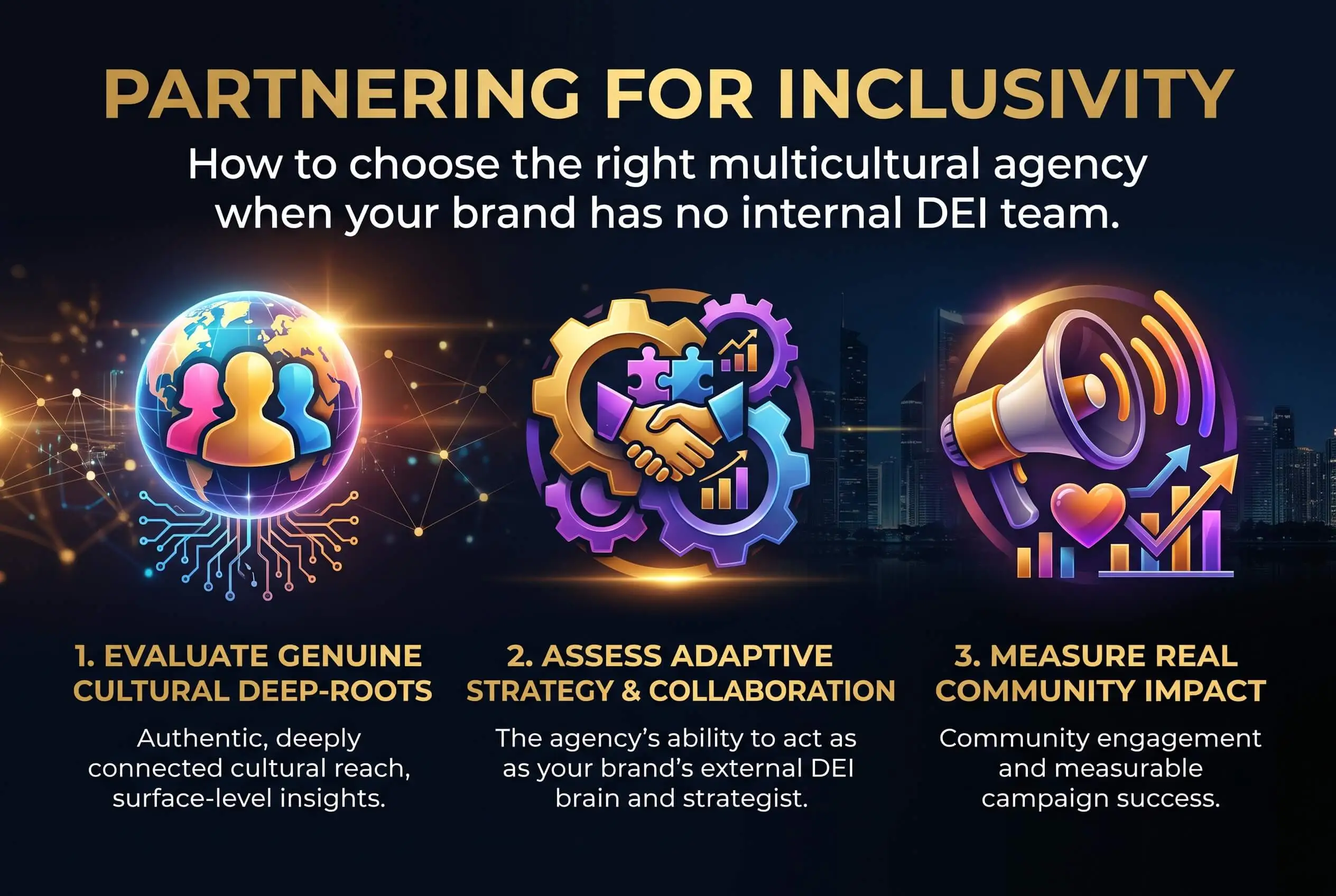
The top multicultural marketing agencies build campaigns from their own team's cultural roots instead of adapting a general-market idea after the fact. When you compare them, look for:
Leadership with lived experience in the audiences you serve
Transcreation by native-language writers rather than word-for-word translation
Ongoing ties to in-language media, community partners and influencers from niche creators to celebrities
A cultural review step with a named owner before anything launches
Results reported by audience segment, with sentiment next to the numbers
In Los Angeles, minority-owned firms such as The Sax Agency combine strategic consulting, public relations, social media management, and urban and event marketing under one roof, which matters most for brands with no internal DEI team.
Top Takeaways
With no internal DEI team, your agency becomes your cultural strategy and review function.
Leadership with lived experience matters more than a diverse pitch team.
Ask for transcreation and visible research, and insist on a named review step before launch.
Favor agencies with long-standing ties to local media, creators and community partners.
Ask for results by audience segment instead of one blended number.
Leave every engagement with written cultural guidelines your team can keep using.
What Top Multicultural Marketing Agencies Do Differently
A multicultural marketing agency builds strategy, creative and media around the values, languages and habits of specific audiences from the first brief. A general agency usually starts with one campaign and adapts it later.
That timing gap matters most when nobody in-house owns culture. Once the team locks a concept, late cultural input can swap a few faces or translate a tagline, and that's about the limit. A minority-owned multicultural marketing agency works in the opposite order. Its people bring their own cultural roots into the insight, the message and the channel plan on day one, and audiences can feel that authenticity.
The top multicultural marketing agencies also refuse to sort people into boxes by background. A second-generation Korean American in Koreatown and a bilingual Mexican American family in the San Gabriel Valley may share some priorities and split on plenty of others. Good agencies plan for those layers, while weak ones flatten everyone into a single "multicultural" persona and move on.
How to Evaluate a Multicultural Agency When No One In-House Owns Culture
Start with the same basics you'd use for choosing the right marketing agency. Then add one more test. You're hiring for judgment your company doesn't have yet, so you need to watch that judgment work before you sign.
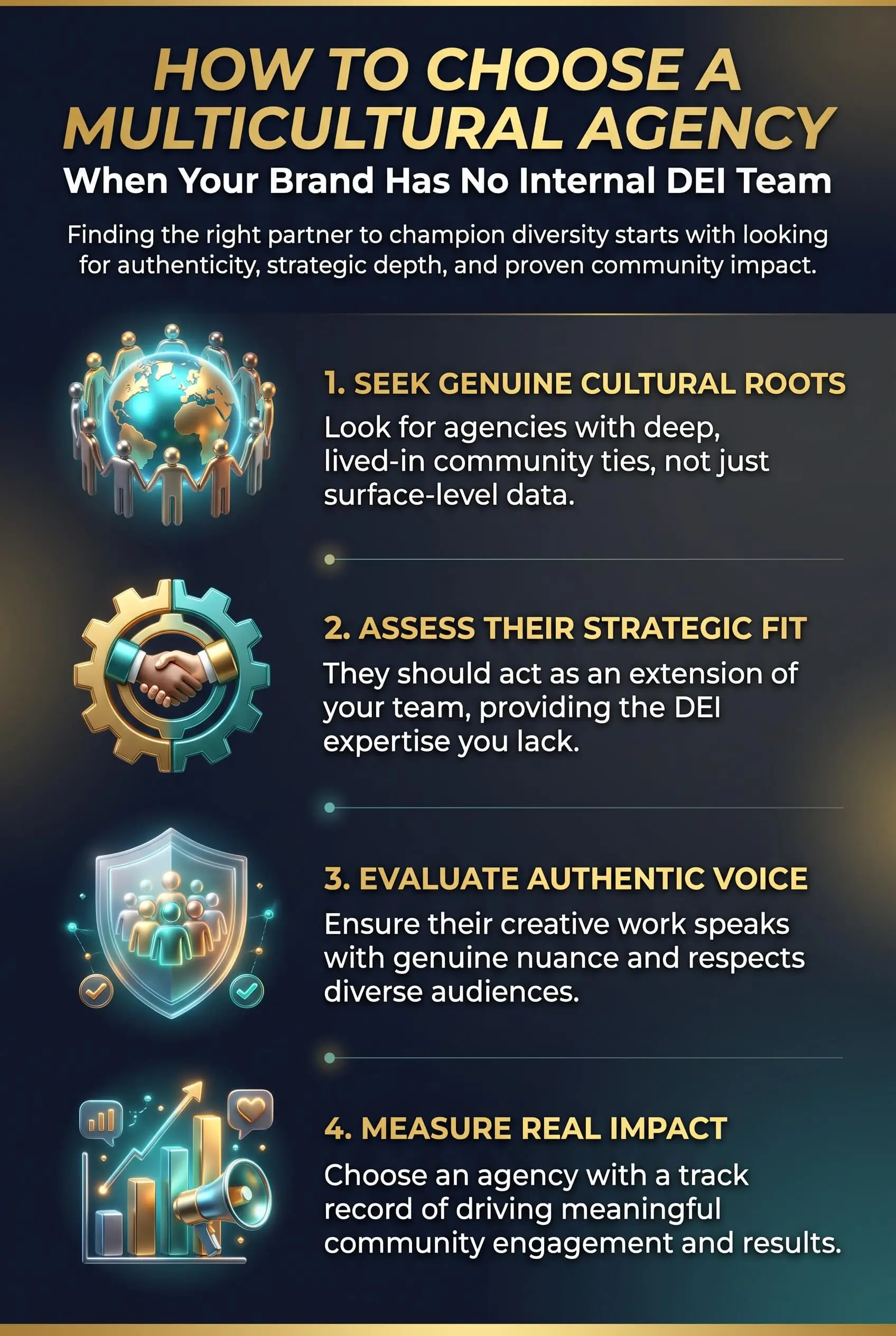
Leadership with lived experience. Ask who sets strategy and who has final say on creative. If the people who share your audience's background only show up in the pitch deck, keep looking. A Black-owned creative agency, for instance, typically puts that perspective in the leadership seat instead of on the bench.
Research you can inspect. A strong partner will show you how its insights get built, from community listening to segment research to testing ideas with people in the audience. If the answer is a slide of census charts, push harder.
Transcreation over translation. Where translation swaps words, transcreation rebuilds the idea, the humor and the imagery so the message lands the way you meant it. Ask who writes for each audience and whether they're native speakers.
Working relationships with communities and creators. Look for ongoing ties to in-language and local media, influencers from niche creators to celebrities, and event partners. Relationships that took years to build open doors a media buy can't.
A cultural review step with a name on it. Without an internal DEI team, nobody on your side is positioned to catch a misstep. The agency needs a defined checkpoint before launch, and you should know exactly who runs it.
Reporting by segment. Ask for results broken out by audience, with sentiment and comments next to the numbers. One blended dashboard hides the very thing you need to see.
Guidance you get to keep. The best agencies leave behind written cultural guidelines and team briefings, so your company knows more after every campaign than it did before.
Multicultural Agency Evaluation Scorecard
Leadership: Ask who leads strategy and approves creative. Green flag: decision-makers share the audience's lived experience. Red flag: diversity that only appears in the pitch.
Research: Ask how they build audience insight. Green flag: primary research paired with community listening. Red flag: generic demographic data and little else.
Transcreation: Ask who adapts copy for each audience. Green flag: native-language writers working from a creative brief. Red flag: copy shipped off to a translation vendor.
Community ties: Ask which media outlets, creators and partners they work with right now. Green flag: named, ongoing relationships. Red flag: vague talk about "access."
Cultural review: Ask what happens before launch. Green flag: a documented checkpoint with an owner. Red flag: "We'll know it when we see it."
Measurement: Ask how they'll report by segment. Green flag: KPIs and sentiment for each audience. Red flag: one blended dashboard.
Knowledge transfer: Ask what your team keeps when the engagement ends. Green flag: written guidelines and briefings. Red flag: nothing beyond the deliverables.
Questions to Ask Before You Sign
Who reviews our creative for cultural accuracy, and what's their background?
Tell us about a campaign that missed the mark. What did you change afterward?
Which communities do you work with directly and on an ongoing basis?
How do you decide whether a piece needs translation or transcreation?
What research happens before you propose a concept?
How will you report results for each audience segment?
Since we don't have an internal DEI team, what will you need from us?
What documentation do we keep at the end of the engagement?
Red Flags That Signal a Poor Fit
One "multicultural" campaign meant to speak to every community at once
Translation handed to an outside vendor with no cultural review afterward
No work samples for the specific audiences you serve
Reporting that never separates results by segment
Big promises about communities the agency has never worked with
No story about a campaign they pulled or changed after community feedback
How to Set Up the Partnership Without a DEI Team
Pick one person inside your company to own the relationship. Culture doesn't need to be their specialty, but accountability does. In the first 60 days, write a short cultural guidelines document with the agency. Build its review step into your approval workflow so no ad slips past it, and sit down every quarter to look at what's landing and what isn't. Over time those habits help you align your brand strategy with your company culture, and multicultural work stops feeling like a side project.
What a Los Angeles Multicultural Partnership Can Look Like
Los Angeles makes the case better than any slide could. The Sax Agency describes the city as home to people from more than 140 countries who speak over 200 languages, so a campaign built for one version of LA misses most of it. As a minority-owned firm based here, The Sax Agency pairs strategic consulting with public relations, social media management, urban and event marketing, and partnerships with multicultural influencers ranging from niche creators to celebrities. For a brand with no internal DEI team, that mix keeps insight, messaging and community presence under one roof as part of a cohesive brand development strategy. It also removes the handoffs between separate vendors, which is where cultural details tend to get lost.
"Most brands without a DEI team assume the agency will cover that gap on its own. Sometimes it does. Often nobody checks. When I sit in on agency reviews, the reel tells me very little. What tells me almost everything is the answer to one question, which is who catches the mistake before it ships. Strong multicultural partners answer with a name, a process and a story about a time they caught one. A pause tells you something too. If your company doesn't have cultural expertise in-house, you're borrowing the agency's judgment, so pick the team whose judgment you've watched in action."
7 Essential Resources
Multiculturalism (Wikipedia): A quick primer on the concept, its history and how different societies define it.
ANA Alliance for Inclusive and Multicultural Marketing (AIMM): The Association of National Advertisers' alliance focused on cultural insight, accurate representation and growth through multicultural marketing.
VAB Multicultural Marketing Agency Directory: Search multicultural-focused agencies by specialty and state when you're building a shortlist.
U.S. Census Bureau: Racial and Ethnic Diversity in the 2020 Census: Official data on how the country's diversity changed between 2010 and 2020, with state and county detail.
Selig Center Multicultural Economy Report coverage (WUGA): A plain-English summary of the University of Georgia's buying power research by racial and ethnic group.
Mediareach: 10 Steps Before Choosing a Multicultural Agency: A practical checklist on credentials, references, case studies and ROI expectations.
Smartling: Six Ways Transcreation Differs From Translation: Useful when you're deciding which marketing content needs transcreation and which can simply be translated.
3 Statistics
The country keeps getting more diverse. The U.S. Census Bureau reports that the chance two people chosen at random belong to different racial or ethnic groups rose from 54.9% in 2010 to 61.1% in 2020.
Multicultural consumers spend trillions. The Selig Center put 2021 buying power at $3.2 trillion for African American, Asian American and Native American consumers combined, plus $2.1 trillion for Hispanic consumers, according to WUGA.
Plenty of companies are working without a DEI function. In a Resume.org survey reported by HR Dive, 1 in 8 companies said they planned to reduce or eliminate DEI programs in 2025.
Final Thoughts and Opinion
Plenty of growing brands have never had an internal DEI team, and others are rethinking where that work lives. Neither situation is a problem by itself. The risk comes from assuming any agency with a diverse About page can fill the gap.
Our take is that accountability should decide this choice. Pick the partner that can walk you through how cultural insight shapes the work and who stops a misstep before your customers ever see it. Ask to see the review step, the research and the relationships, then favor the agency whose answers get more specific the harder you push. A strong top multicultural marketing agency will make your marketing more inclusive, and it will help you earn trust with communities that have learned to spot the difference between being seen and being targeted.
Frequently Asked Questions
What is a multicultural marketing agency?
A multicultural marketing agency plans strategy, creative and media around the cultures, languages and values of specific audiences from the start. A general agency usually adapts a single campaign afterward, while a multicultural firm often draws on its own team's lived experience to shape the work.
Do you need an internal DEI team to work with a multicultural agency?
No, a brand can work well with a multicultural agency without an internal DEI team. Assign one person to own the relationship, agree on shared cultural guidelines and make the agency's review step part of your approval process.
What makes the top multicultural marketing agencies stand out?
The top multicultural marketing agencies stand out because they can show you exactly how they prevent cultural missteps. Look for leadership with lived experience, transparent research, transcreation, ongoing community relationships and reporting by segment.
What is the difference between translation and transcreation?
Translation converts words from one language to another, while transcreation rebuilds the message so its intent, tone and emotional pull land with a new cultural audience. Most marketing and advertising copy needs transcreation.
How do you measure whether multicultural marketing is working?
You measure multicultural marketing by tracking results for each audience segment, including engagement, conversions, sentiment and direct feedback. For a look at where measurement and agency services are heading, see how multicultural marketing agencies are evolving.
Find a Partner Who Fills the Gap
Your customers already reflect how varied America has become, and your marketing and Global communications should keep up with them. Shortlist two or three multicultural agencies this month. Run each one through the scorecard, ask every question on the list and notice who answers with names and examples. Then choose the partner that shows you how culture shapes the work before you've signed anything.


