It's 11 p.m. on a Thursday, payroll clears tomorrow, and you're the only person in the business asking whether that new hire should wait until spring. A fractional CFO, one type of fractional executive, is built for exactly that moment. Think of an experienced chief financial officer who works with you part-time, usually virtually, so you can plan cash with more confidence before the big calls, without a six-figure salary on the books.
Every pricing change and every slow August ends up on your desk. Your bookkeeper tells you what happened last month. Your CPA keeps you on the right side of the IRS. But nobody sits down with you to work out whether the fall hire actually fits the cash you'll have.
That gap is what virtual fractional CFO services are designed to close. The final call stays with you, now backed by clearer numbers and someone in your corner.
TL;DR Quick Answers
Hire the Best Virtual Fractional Part Time CFO Services
The best virtual, part-time fractional CFO is the one you'd call before a big decision, with a forecast ready to back up the advice. If you’re looking to hire the best virtual fractional part time CFO services, here's what to look for:
Forward-looking work: Rolling cash forecasts, often 13 weeks out, plus scenario planning for hires, pricing, and expansion.
The right fit: Experience with owners at your stage and in your industry.
Clear pricing: A weekly or monthly retainer with no surprises. Accountix, for example, starts at $350 per week.
Clean books first: A provider who can pair CFO support with outsourced accounting if your records are behind.
Regular strategy time: Scheduled conversations where you talk decisions through, beyond a monthly report.
Start with a short intro call and bring the decisions you keep putting off.
Top Takeaways
A fractional CFO gives you senior financial guidance part-time, without adding a full-time executive salary.
For owners deciding alone, the biggest win is an expert second opinion before a major decision gets locked in.
Your bookkeeper and CPA report on what already happened, while a fractional CFO plans cash and strategy for what's coming.
Bring one in when your decisions outgrow the information behind them, whatever your revenue.
Get your books clean and current first, since CFO guidance can only be as good as the numbers it's built on.
Why Making Financial Decisions Alone Gets Riskier as the Business Grows
Instinct carries you a long way when the business is small. You can see every customer and most of the risk from one chair. Then growth adds payroll, vendors, and a lot more money moving through the account. The decisions get bigger. The information behind them usually doesn't.
Most owners already pay for good financial help that happens to look backward. Your bookkeeper records transactions, and your CPA files returns and keeps you compliant. Neither one will call you on a Tuesday afternoon to ask what happens to cash if your largest client pays 45 days late, or whether an 8% price increase beats cutting a role.
That's the quiet risk for solo entrepreneurs and lean leadership teams. Owners in this position usually make sound calls. They make them without a forecast or a second opinion, and often long after everyone else has gone home.
What a Fractional CFO Actually Does for an Owner
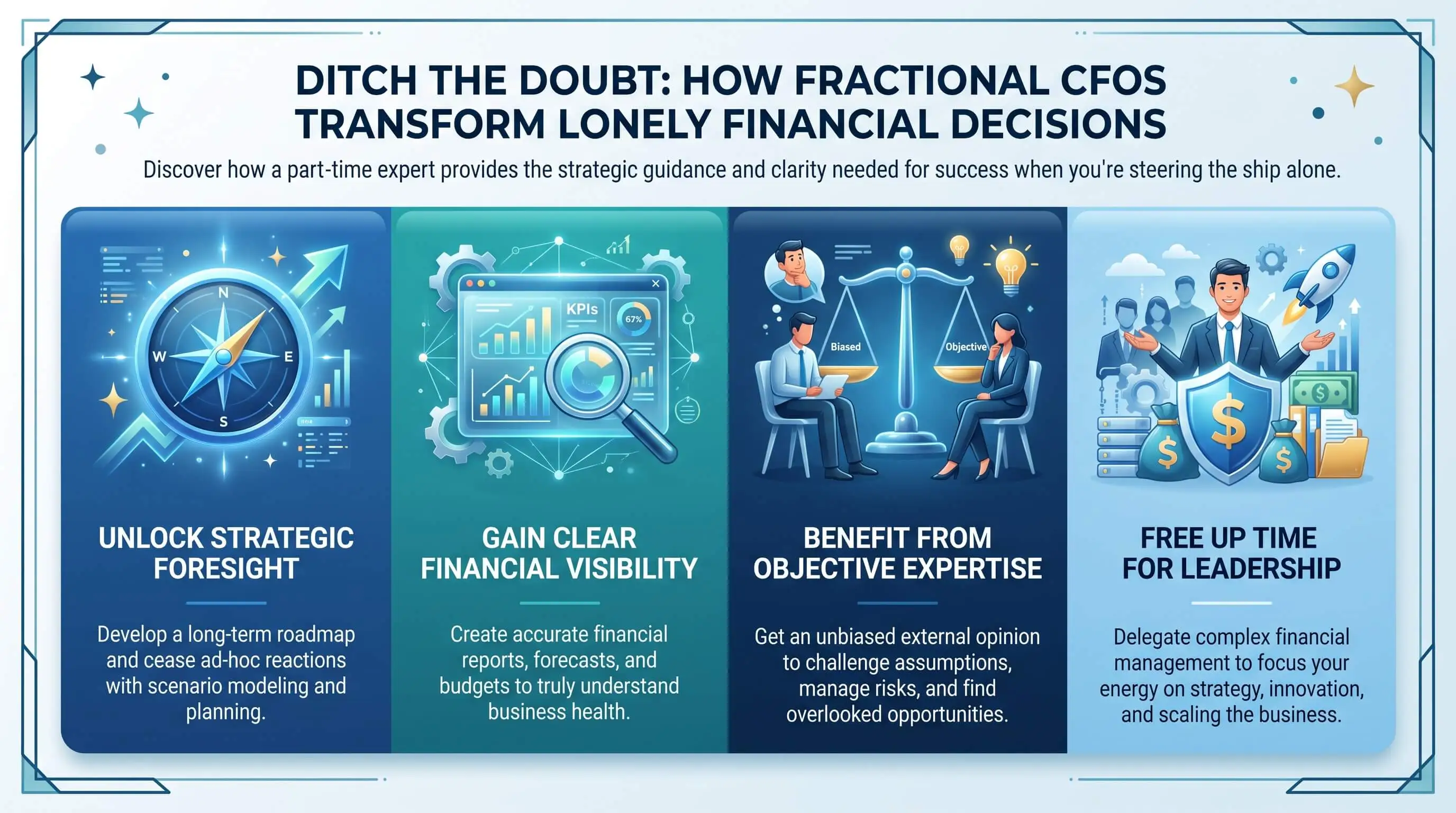
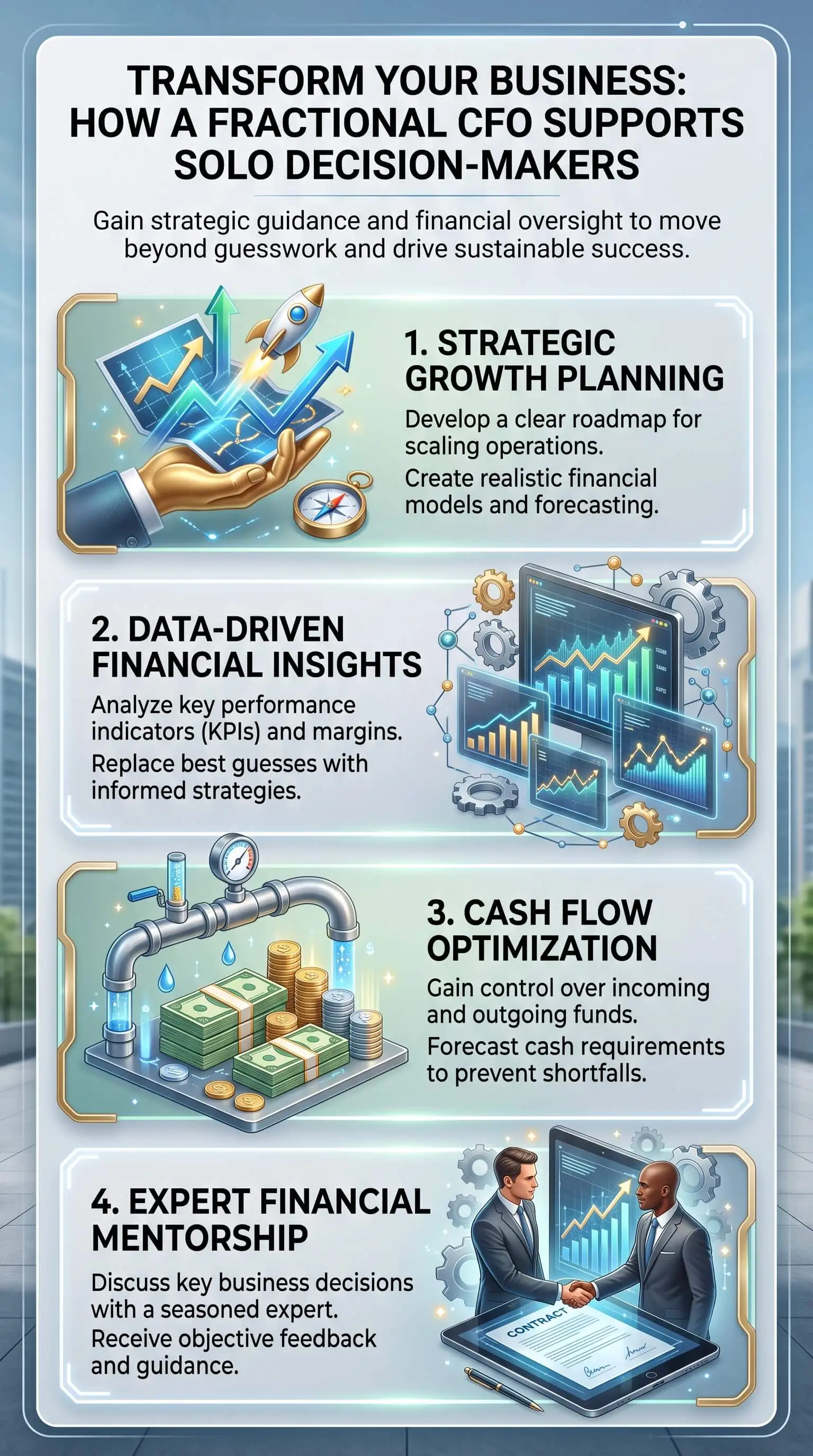
A fractional CFO takes the numbers you already have and turns them into guidance about what comes next. For most owners, that work falls into four areas.
Turns Cash Flow Guesswork Into a Forecast
Checking the bank balance every morning isn't a plan. Your CFO builds a rolling cash forecast, often week by week for the next 13 weeks, so you can spot timing gaps and seasonal dips before they hit. You stay cash flow ready and act earlier instead of scrambling.
Pressure-Tests Big Decisions Before You Commit
Owners who carry every decision alone tend to value this part most. Before you hire, expand, borrow, or reprice, your CFO models a few scenarios and walks you through the likely outcome of each. You still decide. Now you decide with the numbers in front of you and someone to talk it through with.
Shows Which Products, Services, and Clients Make Money
Revenue can hide a lot. When your CFO breaks margins down by product, service, and client, you finally see where profit comes from. That view tends to reshape your pricing and the clients you chase, and it often turns up work you should quietly stop doing.
Builds a Budget You Can Actually Steer By
A budget that sits in a drawer until January helps no one. Your CFO sets one up with a short list of KPIs, then reviews it with you on a steady rhythm. You can adjust while there's still time to change the result.
Fractional CFO vs Bookkeeper vs CPA: Who Does What?
Every one of these roles matters, and each answers a different question.
Bookkeeper: Records and reconciles transactions so your books stay accurate. It answers "What did we spend last month?"
CPA: Handles tax filing, compliance, and year-end statements. It answers "What do we owe, and are we compliant?"
Fractional CFO: Looks ahead with forecasts and decision support. It answers "Can we afford this, and what happens if we do it?"
One honest caveat. A CFO's advice can only be as good as the books underneath it. If your records are behind, reliable small business accounting comes first, and that's why many providers pair outsourced accounting with CFO support.
Signs It Is Time to Hire Part-Time CFO Support
Revenue alone won't tell you when you're ready. The better test is whether your decisions have outgrown the information you use to make them. Watch for these signs:
You can't say with any confidence how much cash you'll have eight weeks from now.
A hire, an expansion, or a price increase is on the table, and you're not sure the numbers support it.
Sales keep climbing while profit and cash stay flat.
A lender, investor, or partner has asked for projections you don't have.
Monthly reports show up on time and still don't tell you what to do next.
You realize nobody but you has ever pushed back on a major financial decision in the business.
What It Costs Compared With a Full-Time CFO
A full-time finance leader is a serious commitment. The U.S. Bureau of Labor Statistics puts the median annual wage for financial managers at $161,700 as of May 2024, and experienced CFOs typically earn more before benefits and bonuses.
Fractional support flips that math. You pay for the involvement your business needs right now, usually weekly or monthly, and adjust as things change. Accountix, for example, publishes fractional CFO pricing starting at $350 per week and tailors the final scope to your stage and complexity. For most small and midsize businesses looking at the best outsourced business and financial accounting firms, that means CFO-level guidance every week instead of none at all.
"We rarely meet an owner who's short on reports. Most have a profit and loss statement they only half trust and a banking app they check every morning. What's missing is someone across the table asking what happens if the plan goes sideways, before any money moves. We once watched an owner hold off on a key hire for nearly a year, only to learn that spring cash flow could have covered it comfortably. Another signed a lease that looked easy on revenue and felt tight on margin within two quarters. A forecast and one honest conversation would have changed both stories. A good fractional CFO gives you a partner in the decision, with the numbers to back it up."
7 Essential Resources
You don't need a paid engagement to get started. These free resources can help you tighten up your numbers and find people to think things through with.
SBA: Manage Your Finances. The Small Business Administration's plain-language guide walks through balance sheets, cost-benefit analysis, and choosing an accounting method. Read it before your first CFO conversation.
SBA Local Assistance Finder. Connects you with free, local business counseling through SBA resource partners, a useful sounding board while you weigh paid support.
America's SBDC: Find Your SBDC. Small Business Development Centers offer one-on-one advising at no cost, including help with tough financial calls.
SCORE Small Business Resilience Training. SCORE's practical training covers planning through disruption and comes with access to free volunteer mentors.
SBA Business Resilience Guide. Helps you plan for risk and recovery, the same scenario thinking a fractional CFO builds into your forecasts.
BLS Occupational Outlook: Financial Managers. Explains what senior finance leaders do and what the role costs full-time, which gives you a fair benchmark for part-time support.
Financial Accounting Standards Board (FASB). FASB maintains GAAP in the United States. Keep it in mind if a lender or investor ever asks for statements that follow a recognized standard.
3 Statistics
94% of small employer firms faced at least one financial challenge in the past year. Nearly every employer firm in the Federal Reserve's 2025 Small Business Credit Survey reported a problem like uneven cash flow or trouble covering operating expenses (Federal Reserve Banks via FRED). Financial pressure is close to universal, and the owners who handle it well tend to be the ones with a plan.
69% of small firms in the Southeast described their financial condition as poor or fair. When the Federal Reserve Bank of Atlanta reviewed 2025 survey data for its district, firms named rising costs, operating expenses, and uneven cash flow as their most common challenges (Federal Reserve Bank of Atlanta). If your cash comes in unevenly, you're in good company, and better planning can fix it.
Small businesses make up 99.9% of all U.S. businesses. The SBA Office of Advocacy counted 34,752,434 of them in its 2024 report (SBA Office of Advocacy). Almost none will ever hire a full-time CFO, and that's the gap fractional CFOs exist to fill.
Final Thoughts and Opinion
Here's where we land. The costliest mistakes we see come from big decisions nobody questioned, and they usually dwarf any CFO fee. Think of the hire made three months too early, or the lease signed on the strength of one good quarter.
Good CFO support keeps you in charge and better informed. You get a forecast you can trust, plus someone whose job is to ask the hard question before the money moves.
It isn't the right move for everyone, though. If your books are months behind, fix that first, because no CFO can forecast from numbers that aren't accurate. And if you're at an early stage with simple finances, a free SBA counselor or SCORE mentor may cover what you need for now.
Still the only person checking the math on every major decision after a few years of growth, with Global communications now part of the picture? Then it's worth a conversation. Plenty of owners make these calls on their own. Nobody says you have to make them without support.
Frequently Asked Questions
What does a fractional CFO do for a small business owner?
A fractional CFO gives you forward-looking financial leadership on a part-time basis. Expect cash flow forecasting, budgeting, margin analysis, and scenario planning for big moves like hiring or expansion. If you've been making those calls alone, your CFO also becomes the person you can think out loud with.
When should I hire a fractional CFO?
Bring one in once your financial decisions have outgrown the information you use to make them. Watch for signals like not knowing your cash position a few weeks out, growth that never shows up as profit, or a lender asking for projections you can't produce yet.
How much do virtual fractional CFO services cost?
Cost depends on your scope and how involved your CFO is each month. Most providers charge a weekly or monthly retainer, and some publish starting rates. Accountix, for example, lists fractional CFO pricing starting at $350 per week. Either way, you'll typically pay far less than a full-time CFO salary plus benefits.
What is the difference between a fractional CFO and a bookkeeper?
Your bookkeeper records and reconciles transactions so the books stay accurate. A fractional CFO uses those numbers to plan ahead, forecasting cash and advising you on decisions. Most businesses need both, and your CFO depends on clean bookkeeping to do the job well.
How many hours does a part-time CFO work each month?
That depends on what your business needs. Some owners want a few hours a month for reporting reviews and planning. Others need weekly involvement during a growth push or a financing round, and a good provider scales the time up or down with you.
Can a fractional CFO work with my existing accountant or CPA?
Yes. Your fractional CFO works alongside your bookkeeper and CPA rather than replacing them. Your CPA stays focused on taxes and compliance while your CFO handles forecasting and strategy, and the two coordinate so each decision reaches the right specialist in time.
How do I choose the best fractional CFO service?
Look for a provider with experience serving businesses your size and in your industry, clear pricing, and regular strategy conversations instead of reports alone. Ask how they'd handle your books if they're behind. Then pick someone you'd feel comfortable calling the night before a big decision.
Stop Carrying Every Financial Decision Alone
Before the week is out, write down the financial decisions you keep putting off. Maybe it's a hire, or an investment you've circled for months. Bring that list to a short, no-pressure conversation with a fractional CFO, and you'll leave with a clearer read on your numbers and someone to help you decide with confidence. No hard sell, just clarity.