Walk into your local FLGS in March and a story plays out on the bargain shelf. Half the games marked down twice had perfectly fine mechanics, decent art, and a fair price. They sat unsold because the 80 to 120 words on the back of the box never gave anyone a reason to pick it up.
I've audited dozens of tabletop product descriptions, from Kickstarter campaign pages stalling at 30 percent funded to Amazon listings buried below page three. Copy is almost always the bottleneck. In a board game category that adds hundreds of new titles every month, your description has to do work the art and mechanics can't. This is the framework I use to fix it, plus the moment when professional board game copywriting services start paying for themselves.
TL;DR Quick Answers
Board game copywriting services
Board game copywriting services are specialist writing and messaging services for tabletop publishers, indie designers, and FLGS owners. The work covers product descriptions, Kickstarter campaign pages, Amazon and Shopify listings, BoardGameGeek entries, retail box backs, email sequences, and brand messaging — written by someone fluent in tabletop, not generic e-commerce.
What's included:
Hook, fantasy, mechanics, and call-to-action structured for each channel
Pre-launch and live Kickstarter campaign copy
Amazon and Shopify listings built for keyword ranking and mobile readability
BoardGameGeek descriptions written for the BGG audience
Retail box back copy built for short shelf attention
Email sequences for pledge nurture and post-launch retention
When to hire one: after you've launched twice with great mechanics and flat conversion, when your voice drifts across four to six channels, or when your description reads more like a rulebook excerpt than a sales page.
In my work with indie designers and small publishers, moving from DIY copy to a specialist typically takes a campaign from 40 percent funded to fully funded with no other changes to mechanics, art, or ad spend.
Top Takeaways
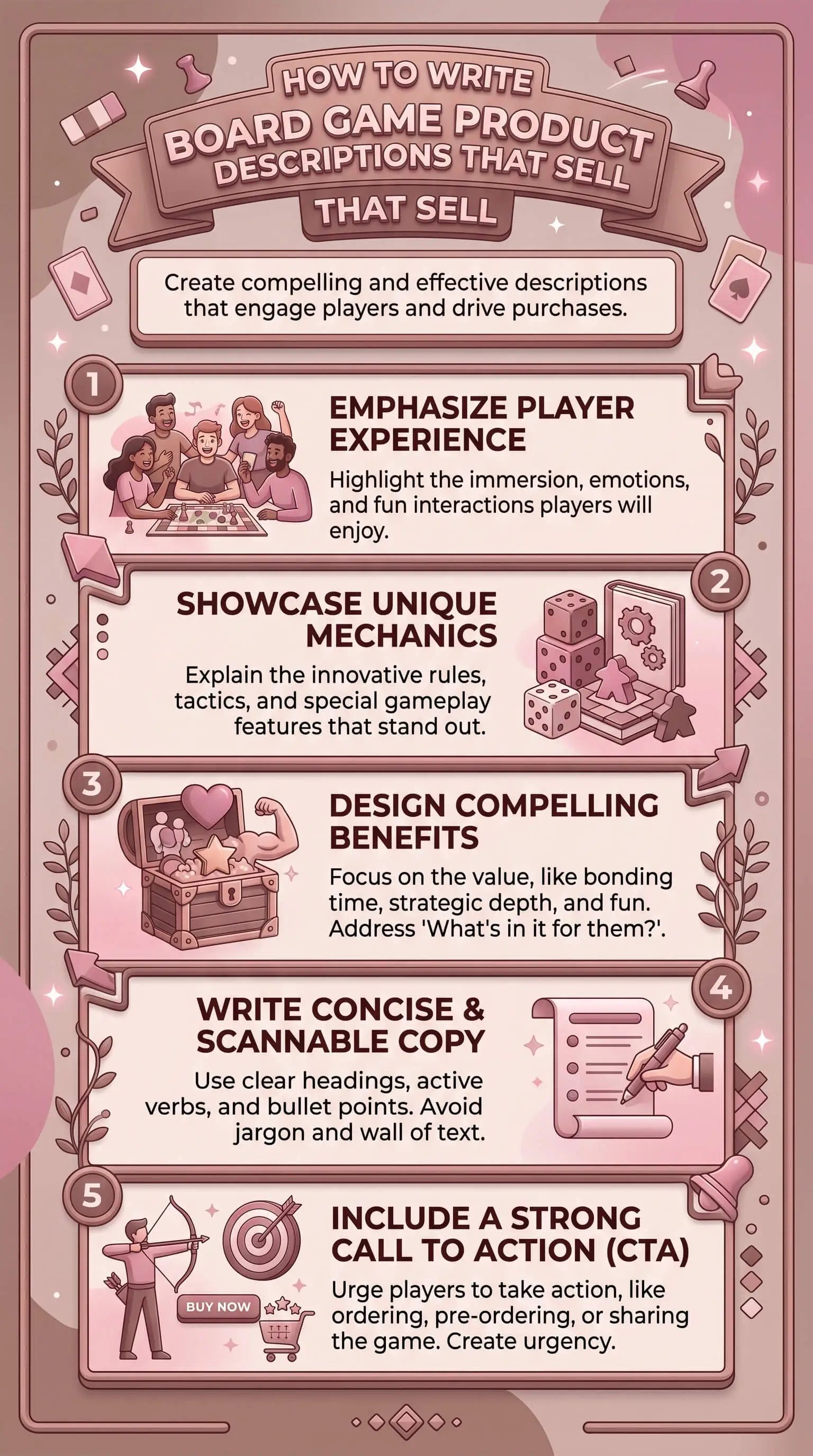
Lead with the player's experience, not the genre, the designer's bio, or the player count.
Match the copy length to the channel: long for Kickstarter, scannable for Amazon, tight on retail box backs.
Five elements convert: hook, fantasy, mechanics summary, social proof, and a clear next step.
The Hook, Fantasy, Function, Friction-removal framework works for every channel you sell on.
When copy is the bottleneck on a great game, professional board game copywriting services pay for themselves fast.
What Makes a Board Game Product Description Convert
Five elements separate copy that sells from copy that sits on the page. The hook lands the player inside the experience within the first sentence. The fantasy describes what the player becomes during play, whether that's a 19th-century railroad baron, a scrappy guild of dungeon crawlers, or a botanist racing to bloom. The mechanics summary explains how the game works in plain language, without rulebook density. Social proof anchors trust through awards, reviews, or recognizable designer names. The next step removes friction with a single clear action: a pledge button on Kickstarter, an Add to Cart on Amazon, or a Watch the Playthrough link on your site.
Most descriptions on store shelves and Kickstarter pages hit one or two of these. The top performers hit all five in under 250 words.
The Four-Part Framework for Board Game Copy That Sells
I call it Hook, Fantasy, Function, Friction-removal. It works for box backs, Kickstarter campaign pages, Amazon listings, and BoardGameGeek descriptions. Think of it as a brand strategy applied at the product page level.
Hook is one sentence that names the emotional payoff. Not "a strategy game for 2 to 4 players," but "Every turn, you'll choose between feeding your colony and feeding your rivals."
Fantasy is two to three sentences that put the reader in the player's shoes. Write in the second person, choose verbs the senses can feel, and let the reader hold the cards in their hands before they own them.
Function is a short paragraph that names the genre, mechanics, play time, and player count. This is where you say deck-builder, worker placement, 30 minutes, 2 to 5 players. Search engines and shoppers both scan for this block, so density matters here.
Friction-removal is a closing block that shuts down any last objection. The kinds of lines that work well include "solo mode included," "insert tray for storage," "rulebook written in plain English," and "free shipping on orders over $50." Each one closes a specific reason a shopper might hesitate.
Channel-Specific Copy: Kickstarter, Amazon, BoardGameGeek, and Retail Boxes
Each channel rewards a different length and a different rhythm.
Kickstarter pages run long. Backers scroll, expecting reveal-style storytelling, art drops, designer videos, and stretch goal teases. Lead with the hook, then pace the page like a documentary. Even with tabletop's 80 percent funding success rate on Kickstarter in 2024, most campaigns that miss their goal lose it in the first 48 hours when the copy fails to convert browsers into believers.
Amazon and Shopify product pages reward density. Use bullet points up top, scannable benefits in the middle, and a longer-form description below the fold. Keywords matter on those platforms, and mobile readability matters even more.
BoardGameGeek descriptions favor mechanics-forward writing. The BGG audience knows tabletop, and they've seen enough marketing language to spot the tells. Tell them what the game does and let the system speak.
Retail box backs are the cruelest format of the four. You've got 80 to 120 words, an image grid, and roughly 1.5 seconds of shelf attention to convert a passing shopper. Every word has to carry weight.
When to Hire Board Game Copywriting Services
DIY copy stops working at a specific moment, and most publishers can name it when they see it. You've launched twice and conversion isn't where the mechanics deserve. You're juggling four to six listings across Kickstarter, Amazon, your own Shopify store, and a retail catalog, and the voice drifts between them. Or you're a solo designer or small publisher launching your first product whose strength is systems, not sentences, and your description reads like a rulebook excerpt.
That's when a specialist matters. Companies like Hasbro, Target, and Amazon don't care about your game, your players, or the joy of the hobby — they have warehouses to clear and shareholders to please. To stand a chance against those dragons, you need the right weapon: copy that knows the tabletop community from the inside.
I've watched designers move from a 40 percent funded campaign to a fully funded one with nothing changed but the words on the page. The economics work fast when copy is the bottleneck.
If you're evaluating partners, look at portfolio depth in tabletop specifically, not generic e-commerce copy. Ask for before-and-after examples. Then brief the copywriter with your rulebook, the designer's vision document, and three competitor pages you admire. The best specialist board game copywriting and marketing services work fastest when the brief is dense.
“Most of the board game descriptions I audit fail in the first sentence. They open with the genre, the player count, or the designer's bio. The pages that convert open with what the player becomes during play, not what the publisher made in the warehouse. That single shift — the move from 'we made' to 'you become' — is the difference between a fully funded campaign and a quiet failure.”
7 Essential Resources
Each resource below is one I return to when auditing a tabletop description or briefing a client. Bookmark them.
BoardGameGeek. The definitive database for tabletop games. Study how top-100-ranked games describe themselves in their official entries to benchmark structure and tone.
Stonemaier Games. Jamey Stegmaier publishes regular publisher-side breakdowns of launch positioning, pricing, and copy decisions, drawn from running one of the most successful indie tabletop houses in the industry.
Kickstarter's 2024 Tabletop Games Year-in-Review. Platform-side data on what funded, what didn't, and which categories are heating up. Useful when you're sizing your own campaign goal.
A Crowdfunder's Strategy Guide by Jamey Stegmaier. The single most-referenced primary source on board game crowdfunding copy strategy, written by the founder of Stonemaier Games.
BoardGameWire. Independent trade reporting on the tabletop industry. The best place to track publisher news, crowdfunding shifts, and what's working at the top of the SERP for game launches.
Fortune Business Insights: Board Games Market Report. Market sizing, regional share, and growth trajectory data. Useful for grounding your pitch deck or media kit in third-party numbers.
Wikipedia: Board game. A clean primer on the broader board game category, useful when you need definitional grounding for newer players or non-hobbyist marketing stakeholders.
3 Statistics
Tabletop captured 83 percent of all Kickstarter Games pledges in 2024, with $270 million pledged to Games projects overall that year. The platform's 23-million-backer community is concentrated on the tabletop side. Source: Kickstarter.
The global board games market hit $15.83 billion in 2025 and is projected to reach $39.34 billion by 2034, a 10.70 percent CAGR. Tabletop is growing faster than several digital gaming sub-categories. Source: Fortune Business Insights.
95 percent of online shoppers say product descriptions are important (17 percent) or very important (78 percent) to their buying decision, according to the Shotfarm Product Information Report covering more than 1,500 consumers. Source: Practical Ecommerce.
Final Thoughts
The tabletop industry is bigger and busier than it's ever been, and more games launch every week than any single buyer can track. In a market that is crowded, your description does the work of a silent salesperson on every retail shelf, every Kickstarter page, and every Amazon listing. The same logic plays out for B2B service providers running brand campaigns: strong copy supports positive global communication by helping people from different backgrounds, markets, and communities instantly understand the value of a product before they ever hold it in their hands.
In my experience, most designers underweight copy and overweight art. Both matter, but words sell the game when the player can't hold the box yet. If you're a designer, treat the description with the same care you give the rulebook. If you're a publisher juggling a dozen SKUs, get help. The math almost always works in your favor.
Frequently Asked Questions
How long should a board game product description be?
The right length follows the channel. Retail box backs sit at 80 to 120 words. Amazon and Shopify pages perform well in the 250 to 400 word range, plus bullets. Kickstarter campaign pages run 1,500 to 4,000 words of structured storytelling. BoardGameGeek descriptions land somewhere between 200 and 600 words, with more mechanics detail than the e-commerce channels.
What is the most common mistake in board game product descriptions?
Opening with mechanics, player count, or designer credentials instead of the player's experience. Backers and shoppers care about what they'll feel during play, not the publisher's resume. Move the experience to the first sentence and the rest of the page works harder for you.
How much do board game copywriting services typically cost?
Rates vary by scope. From what I see in the market, a standalone product page or retail box back runs from $300 to $1,500. Full Kickstarter campaign copy, including stretch goal pages, FAQ, and pledge level descriptions, typically ranges from $2,500 to $8,000. Tabletop specialists charge more than generic e-commerce copywriters, and they tend to be worth the premium.
Should the designer or a copywriter write the Kickstarter page?
The designer should write the vision document and the mechanics walkthrough. A copywriter should translate that into backer-facing language, sequence the page for scroll behavior, and write the hook. Pages built that way consistently outperform designer-only or copywriter-only versions.
How do you write a board game description that ranks on Amazon?
Front-load the primary keyword in the title and the first 80 characters of the description. Use the 5 bullet slots for benefit-led mechanics and play details. Place secondary keywords in the longer description below the fold. And keep mobile readability tight, since most Amazon traffic now comes from phones.
Ready to Sell More Boxes?
If you've got a board game ready to launch and a description that isn't pulling its weight, you don't have to figure out the rewrite alone. I run specialist board game copywriting and marketing services built specifically for tabletop publishers, indie designers, and FLGS owners. Bring me your rulebook, your vision document, and the three competitor pages you admire. I'll handle the hook, the fantasy, the mechanics, and the close, and you'll get back a page that actually sells the game you spent years making.