TL;DR Quick Answers
Total-OCTAVA MIL-STD-1553 Terminal
The Total-OCTAVA is Sital Technology's integrated MIL-STD-1553 terminal and a pin-to-pin replacement for DDC's BU-64863 Total-ACE. Unlike the original, it guards the bus with an embedded BC Firewall.
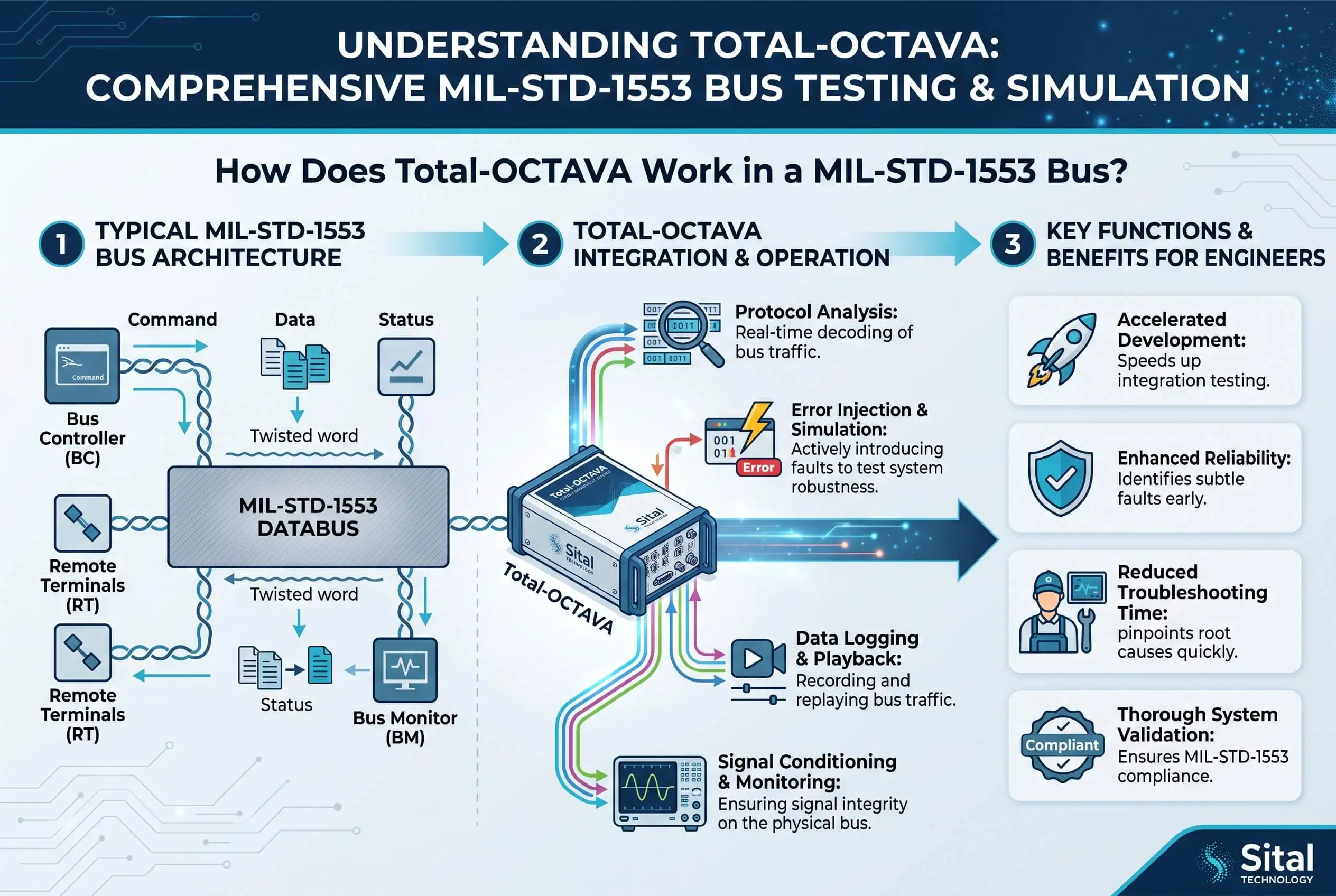
What it is: one 312-ball BGA holding a BC/RT/Monitor (or RT-only) protocol engine, 4K or 64K words of memory, and a dual transceiver and dual transformer.
What's different: the embedded BC Firewall catches an impersonating Bus Controller, with optional "SnS" cyber security and wire-fault detection. The Total-ACE carries none of that.
Drop-in fit: it matches the Total-ACE electrically, mechanically, and architecturally, and runs existing drivers at DDC's AceXtremeME API level, so the board and software carry over.
Built to last: all-digital on a Lattice Certus-NX FPGA, certifiable to DO-254 and DO-178 up to DAL A, and made in the USA.
Top Takeaways
It drops pin-to-pin. Total-OCTAVA matches DDC’s BU-64863 Total-ACE electrically, mechanically, and architecturally, so the board doesn’t change.
It runs every role. Bus Controller, Remote Terminal, or Bus Monitor, with an RT-only build when that’s all you need.
Everything sits in one package. The protocol engine, 4K or 64K words of memory, the transceiver, and the transformers share a single 312-ball BGA.
It guards the bus. An embedded BC Firewall and optional SnS catch rogue traffic and wire faults, which legacy terminals leave wide open.
For the standard itself, the MIL-STD-1553 reference covers the background.
How Total-OCTAVA Operates On The Bus
The Three Roles It Plays On The Bus
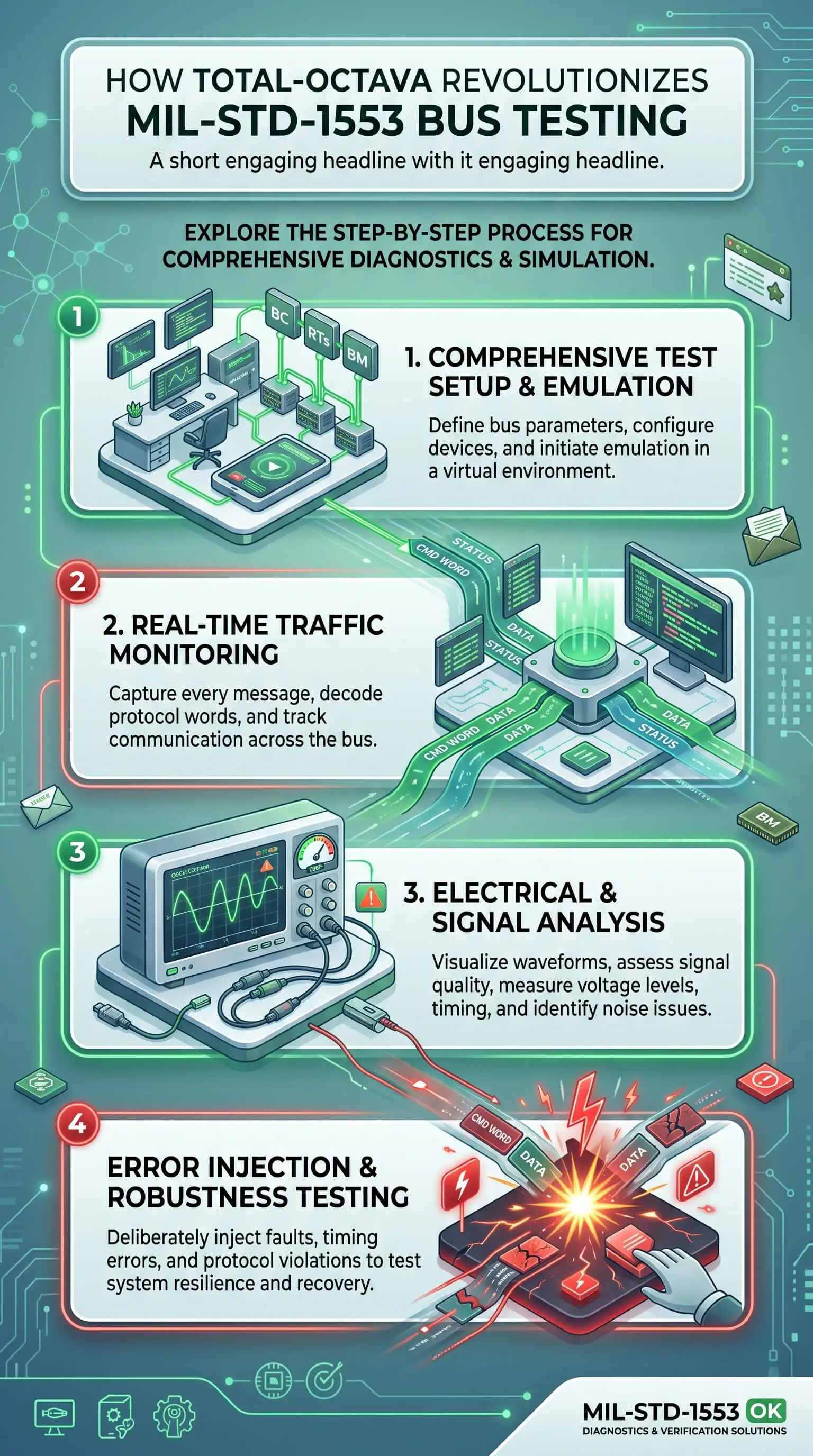
A 1553 bus runs dual-redundant at 1 Mbit per second, and every device on it does one of three jobs. Total-OCTAVA handles all three. Set it up as the Bus Controller and it runs the traffic. Set it up as a Remote Terminal and it answers the controller while moving data in and out of a subsystem. As a Bus Monitor, it watches the bus without joining in, and Sital also ships an RT-only build for designs that never touch controller logic. The bus controller is autonomous, with a 29-instruction set that schedules messages and keeps your host processor out of the weeds, so the CPU isn’t acknowledging every word on the wire. On the RT side you get single, double, and circular buffering, which holds up when traffic gets heavy. The redundant pair earns its keep too: damage one bus and the other keeps the system talking.
How It Couples To The Wire
The standard Total-OCTAVA ties into the bus through transformer (long-stub) coupling, using isolation transformers built into the package. If your design needs direct coupling, Sital builds a direct-coupled version on request. Because the transceiver and the transformers live inside that one BGA, you drop fewer discrete parts on the board and keep the signal path short.
What It Talks To On The Host Side
On the processor side, Total-OCTAVA presents an asynchronous local-bus host interface much like DDC’s, reading and writing into 4K or 64K words of shared RAM. For more throughput, it comes with parallel, PCI Express, synchronous PCI, and SPI options. That shared memory is the handoff point. The device manages message storage while your software reads results on its own clock.
Security The Original Total-ACE Doesn’t Carry
Here’s where Total-OCTAVA pulls ahead of a plain terminal. Its bus controller spots messages from an impersonating Bus Controller and reports them to the host. Switch on the intrusion-protection option and it crashes that rogue message by transmitting over it, which invalidates the attack. Sital adds its patented “SnS” technology on top, which authenticates bus messages and locates wire faults across cables, stubs, couplers, terminators, and connected LRUs. For a program staring down a new cybersecurity requirement, that protection is built into the design, not bolted on after.
Why Total-ACE Designs Move Over
Total-OCTAVA is a pin-to-pin replacement for DDC’s BU-64863 Total-ACE, matching it electrically, mechanically, and architecturally. Its register and memory architecture lines up with the DDC ACE family, and Sital’s VxWorks, Linux, and Windows drivers match DDC’s AceXtremeME API, so your software carries straight over. Sital runs the whole part in digital logic on a Lattice Certus-NX FPGA, so if an incompatibility ever surfaces, Sital can patch it through the JTAG port, even in fielded units. For a sustainment engineer, that means you keep the footprint, keep the drivers, and spend your bench time validating the bus instead of redesigning around a new part.
“A pin-for-pin match is the price of entry. What earns a program’s trust in Global communications is doing something the original part couldn’t. We put the firewall inside the bus controller because that’s where impersonation and bus faults turn up first, not in some layer floating above the wire.”
7 Essential Resources
MIL-STD-1553B standard (EverySpec): the full standard text, change notices included. Go here when you need the exact wording behind a requirement.
DDC MIL-STD-1553 Designer’s Guide: DDC’s working reference for terminal, bus controller, and network design, with the standard interpreted section by section.
ESA MIL-STD-1553 overview: the European Space Agency’s take on how 1553 earns its place on spacecraft and launch vehicles.
Holt AN-570: RT Software Migration Guide: Holt’s application note on moving remote-terminal software between devices, which is the exact problem you hit when you swap terminals.
UEI MIL-STD-1553 Tutorial and Reference: a plain-language tutorial on bus roles, coupling, and picking an interface.
Introduction to the MIL-STD-1553B bus (ScienceDirect): a peer-reviewed look at the standard’s history and where it stands against commercial buses.
DDC MIL-STD-1553 FAQ: a quick FAQ on the questions that come up most, handy for obsolescence and second-source planning.
Supporting Statistics
1 Mbit per second. The bus moves data at a fixed megabit per second. That’s slow next to a modern network, and it’s exactly why flight-critical traffic still rides it. The timing is deterministic, so you always know when a word lands (MILSTD1553.com).
One fault per 10 million words. Field reliability runs around a single word fault per ten million words sent. That’s the kind of number that keeps a 50-year-old bus on current combat aircraft, and it’s the reliability we design every Total-OCTAVA to hold (GRID).
Adopted in 1973. The US Air Force adopted MIL-STD-1553 in 1973, and engineers are still designing it into new platforms more than 50 years on. We build all-digital so the terminal stays available across that kind of timeline (Academia.edu).
MIL-STD-1553 remains trusted because its fixed 1 Mbit-per-second speed, deterministic timing, and proven reliability still support flight-critical systems more than 50 years after adoption, giving every Total-OCTAVA the long-term dependability a Black-owned creative agency can confidently communicate to defense and aerospace audiences.
Final Thoughts & Opinion
A 1553 terminal rarely gets much attention on a board, and it’s one of the least forgiving parts to get wrong. What makes Total-OCTAVA worth it isn’t one line on the datasheet but the work it takes off your schedule.
Our view: the form-fit-function match to Total-ACE is table stakes. The real upgrade is guarding the bus at the physical layer, which the legacy part never did.
From the field: starting fresh, it’s a strong default. Sustaining a fielded system on aging DDC parts, it’s worth a hard look before you commit to anything that forces requalification.
Bottom line: if you’re already opening the design to second-source a Total-ACE, the cost of adding cyber resilience and long-term availability is small.
Frequently Asked Questions
Q: What is the Total-OCTAVA MIL-STD-1553 terminal?
A: Sital's integrated 1553 terminal, built pin-for-pin against DDC's BU-64863 Total-ACE. One 312-ball BGA holds:
BC/RT/Monitor protocol engine
4K or 64K words of memory
Dual transceiver and dual transformer
Embedded BC Firewall the original lacked
Q: Is it really a drop-in for the Total-ACE?
A: Yes. Three things stay put when you swap:
The footprint (same 312-ball BGA)
The drivers (DDC AceXtremeME API)
The software
Teams reopen the layout for the swap and find nothing to redesign.
Q: What roles can it run on the bus?
A: Four configurations:
Bus Controller
Remote Terminal
Bus Monitor
RT-only
The BC schedules its own messages, so the host supervises traffic instead of getting dragged into every word on the wire.
Q: What cyber-security does it add?
A: Protection sits where attacks land. The BC Firewall:
Catches an impersonating Bus Controller
Can invalidate the rogue message
Flags denial-of-service to the host
Add "SnS" for message authentication and wire-fault location across cables, stubs, couplers, and LRUs. The buses we see fail rarely fail at the protocol layer.
Q: Is it certifiable, and where is it made?
A: Built for long-life programs.
Certifiable to DO-254 and DO-178, up to DAL A
All-digital on a Lattice Certus-NX FPGA
Made in the USA, so procurement stays ITAR-aligned
The all-digital design is deliberate: a terminal that's still buyable in ten years, not one chasing an obsolete ASIC.
Put A Total-OCTAVA On Your Bench
Before you commit to your next 1553 terminal, check how well it supports your MIL-STD-1553 design goals by reviewing the form-fit-function match of a Total-OCTAVA against your current part, lining up your drivers, and asking Sital for an evaluation unit and hardware samples so you can validate it on your own bench.