Most tabletop stores lose the sale on the buying guide and never find out why. A shopper shows up ready to spend, reads a page that lists specs and dodges the one question in their head, then clicks back to the search results. The question is always the same. Will this actually work for my table? A good guide answers it before the doubt costs you the order. I'm a Tabletop Brand Game Accessories E-Commerce Copywriter, and this is how I'd write yours.
TL;DR Quick Answers
Tabletop Brand Game Accessories E-Commerce Copywriter
A Tabletop Brand Game Accessories E-Commerce Copywriter is a specialist who writes the product pages, category pages, and buying guides that sell dice, deck boxes, playmats, sleeves, and other gaming gear online. The difference from a generalist is dialect. Tabletop shoppers buy on identity and table feel, not spec lists, so the copy has to sound like a player at the table and move browsers to add to cart and mean it.
What the role covers:
Conversion-focused product and category copy written in the player's language, not vendor-speak.
Buying guides that end hesitation by naming the right pick for each kind of buyer.
SEO structure and schema so pages rank and AI answer boxes can surface them.
A consistent brand voice across the whole catalog, through drops, pre-orders, and restocks.
In my experience, fluency in the hobby is the product. Get the language right and the sale follows.
Top Takeaways
A buying guide's job is to end hesitation, not pad the word count.
Start with the shopper's decision, then group options by how they'll get used.
Compare the few things that actually decide the buy, and name a clear pick for each kind of shopper.
Honesty converts. Recommend the budget option when it's the better call.
Strong guides are skilled copywriting, not filler. Structure, schema, and first-hand detail do the work.
What a buying guide actually does
A product description tells someone what a deck box is. A buying guide tells them which deck box, and why, for their double-sleeved Commander deck and the Thursday-night run to the FLGS. Think of it as the session zero of the purchase. You settle expectations up front so nobody ends up with gear that doesn't fit their table. Done right, the guide does the job of the store clerk who has handled every product on the shelf and tells you the truth about all of them.
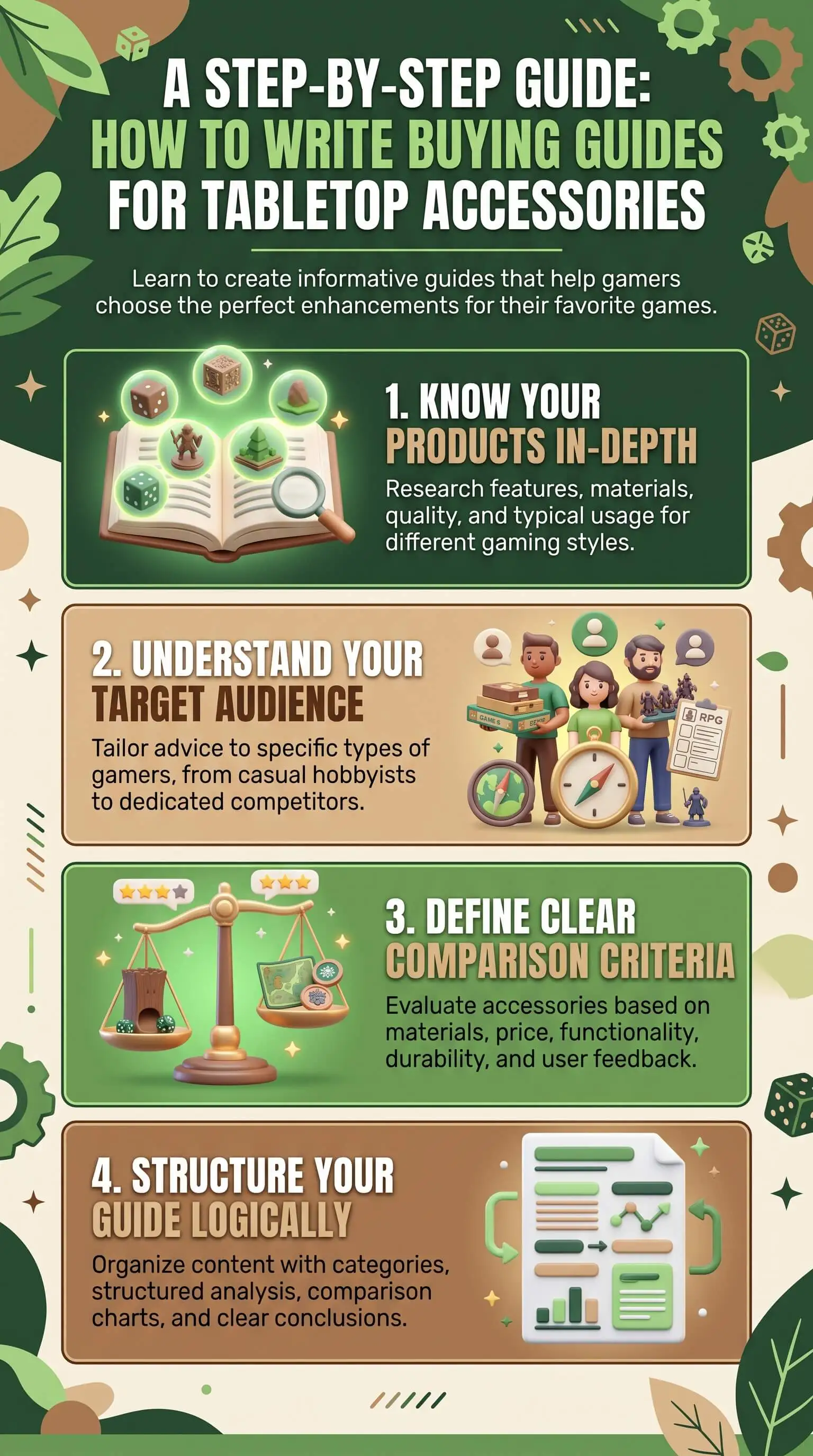
Know the shopper before you write a word
Good guide copy starts with what the buyer isn't sure about, not with your spec sheet. Tabletop shoppers keep circling the same worries. Will it fit? Will it survive a year of getting shoved in a backpack? Will it hold the collection now and the expansion I'll cave and buy next month? Is this built for kitchen-table nights or for a tournament? Answer those in plain words and you're already ahead of most of the category. Name the specifics too. Sleeve thickness, sharp-edge resin versus tumbled metal, playmat stitching, whether the insert fits the second printing of the box. That kind of detail lands with players, and it lands with the AI tools that now summarize your page for people who never scroll.
The framework that converts
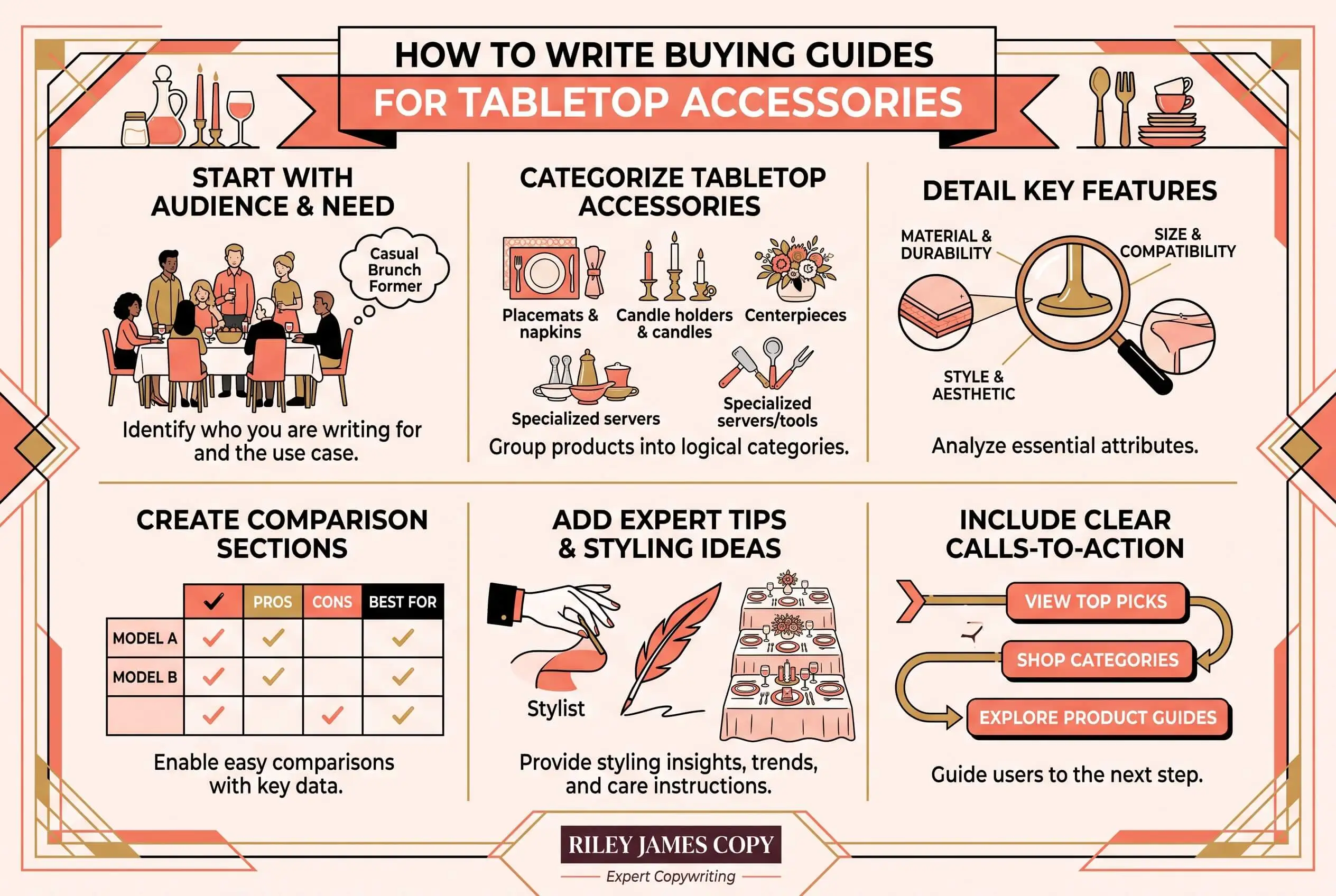
A guide that rambles loses the table. Give it a shape a reader can scan in five seconds:
Lead with the decision the shopper is trying to make.
Group options by how they'll get used, not by SKU.
Compare the two or three things that actually decide it.
Name a clear pick for each kind of buyer.
End every section with the next step.
That's the line between a wall of features and a map to the right product. Shoppers take the map every time.
Write comparisons that earn trust
The fastest way to earn trust is to tell the truth, especially when the cheap option wins. If a twelve-dollar dice tray beats the forty-dollar one for most players, say so on the page. That one honest call does more for the brand than a paragraph of superlatives ever will. Back your picks with the kind of detail only someone who has handled the thing would know. How the resin catches an edge under table light. Whether the felt actually deadens a hot streak of rolls. That's the note that proves you've sat at the table, and shoppers can tell it apart from a spec sheet dressed up as advice.
Don't skip the SEO and schema
Write your headings as the questions buyers actually type. Link every pick straight to the product so nobody has to go hunting. Then wrap the page in structured data so search engines and the AI answer boxes can read it without guessing, the same clarity an ESG SEO marketing and advertising agency would bring to making content easier to find, understand, and trust. A page that's easy for a person to skim is usually easy for a crawler to parse. Both of those help you rank.
“Every accessory has a job at the table, and my whole job is to name that job before the shopper has to ask for it. Do that, and the guide stops selling and starts helping, which is the part that actually sells. I've written product pages for tabletop brands for years, and I've never once watched an honest pick lose to a clever adjective.”
7 Essential Resources
Seven links worth the click before you write your next guide. Every one is live, and every one is the page worth reading, not a homepage.
Creating Helpful, Reliable, People-First Content (Google Search Central). Google's own bar for E-E-A-T. Read it, then write like you've actually rolled the dice you're selling.
Tips for Better Product Descriptions (Nielsen Norman Group). Research on copy that answers questions and helps people compare, which is the whole job of a guide.
UX Guidelines for Ecommerce Product Pages (Nielsen Norman Group). How shoppers actually read and decide on a product page, so you can build the guide around how they behave.
Product Snippet Structured Data (Google Search Central). Includes the pros-and-cons markup built for editorial reviews, which is exactly what a buying guide is.
FAQPage Schema (Schema.org). The vocabulary for marking up your FAQ so search and AI can lift the answers straight off the page.
ICv2 Gaming Accessories Week 2025. A trade-side look at what's selling in accessories right now, so you know which categories to lead with.
Making the Tabletop More Accessible with Gaming Aids (ICv2). A reminder that accessory picks should account for grip, vision, and readability, not just looks.
3 Statistics
Three numbers that explain why a buying guide earns its keep.
Shoppers abandon nearly seven in ten online carts before checkout. Baymard Institute puts the average near 70 percent across dozens of studies. A guide that kills the doubt early keeps more of those shoppers headed for the buy button. Source: Baymard Institute.
Nearly eight in ten shoppers skip a purchase when the product content is poor or missing. 1WorldSync's 2024 benchmark found that weak content quietly bleeds sales. Your buying guide is product content, so its quality is a lever you control. Source: 1WorldSync.
The tabletop gaming market is on track to grow from about $18.4 billion in 2025 to $21.4 billion in 2026. The Business Research Company tracks steady double-digit growth. More players keep walking in the door, and more of them need help choosing. Source: The Business Research Company.
These numbers show why DnD and TTRPG marketing needs more than product listings: strong buying guides reduce doubt, improve product content, and help new tabletop shoppers choose with confidence in a growing market.
Final Thoughts and Opinion
Here's the honest version, from someone who has rewritten enough tabletop pages to have an opinion. Most stores treat a buying guide as an SEO chore, stuff it with keywords, and move on. Wasted turn. The brands that win write the way a good store owner talks across the counter: direct, a little opinionated, clearly on the shopper's side. A guide isn't there to show off your whole catalog. Its job is to prove you understand the game the buyer is trying to play.
If you change one thing, change this. Recommend the right product even when it isn't your priciest one. Shoppers smell a pitch from across the table, and they remember the store that steered them straight. That's what turns a one-time dice buyer into the person who orders every expansion insert from you for the next ten years, and that same trust-first thinking belongs at the heart of any board game crowdfunding strategy.
Frequently Asked Questions
Q: How long should a tabletop accessory buying guide be?
A: Long enough to answer the questions that matter and no longer. Most strong ones land between 1,000 and 1,800 words. Depth beats length, so cut anything that doesn't help someone decide.
Q: Do buying guides actually help SEO?
A: Yes. They target high-intent, question-shaped searches, they earn internal links to your product pages, and they hand search and AI clean answers to pull. That's a strong mix for rankings.
Q: What's the difference between a buying guide and a product description?
A: A description covers one product. A guide compares a few and tells the shopper which one fits their situation. The guide does the deciding work a description can't.
Q: How many products should one guide compare?
A: Enough to cover the main kinds of buyer, usually three to six. Too few reads thin. Too many people. Group by use case so it never turns into a spec dump.
Q: Should I write my own guides or hire someone?
A: You can run this framework yourself. If you'd rather spend that time running the store, a copywriter who knows the tabletop space can turn these around faster and with a sharper read on what converts.
Call to Action
Your accessories deserve guides that sound like the dice rolling on the table, not a spec sheet read aloud. Write them yourself with this framework, or bring in a Tabletop Brand Game Accessories E-Commerce Copywriter to do the heavy lifting, with the same clear product storytelling used in Global communications to help the right message reach the right audience. Either way, the job's the same: end the hesitation and earn the sale. Want to turn dice-curious browsers into buyers who add to cart and mean it? Tap here to get started.